

Crystal Resonance
High Vibrational Well-Being from the Earth and Beyond
By Kerry Nelson Selman
https://www.goodreads.com/review/show/6207201799
“Everything in life is vibration,” states Albert Einstein
Vibration in quantum physics means everything is energy. Everything in the universe is in motion, whether solid, liquid, or gas.
Selman says, “We live in a world of vibration, separated by only frequency of vibration.”
“We are energy; our complex physical bodies are nourished and sustained as energy continually transforms and cycles from thermal, to mechanical, to electrical, to kinetic and other forms of energy – vibration, movement, and change are basic to life; without movement, we cannot grow physically, mentally, emotionally or spiritually.”
Margotdeepa Slater-Oliphant, Creator of Newlife Reiki Seichim in Australia states in the forward to this book, “Anyone with an interest in crystals, aromatherapy, flower essences, healing and the body/mind connection will enjoy this book. It has plenty of juicy information waiting to be savored, and it’s easy to read.”
Kerry Nelson Selman is from New South Wales in Australia, and she holds Advanced Diplomas in Naturopathy, Herbal Medicine, and Nutritional Medicine, a Master Aromatherapist Diploma, a Diploma in Advanced Crystal Healing, and Reiki certificates.
Selman states, “In 2013, my appreciation of synergy, curiosity about what is possible, passion for simplicity, and inspiration coalesced to develop these crystal synergistic combinations as a healing and self-enhancing lifestyle practice that restores balance and brings awareness to our inherent wellness and well- being. I have learned that crystals, essential oils, and flower essences can be synergistically combined for optimal resonance frequency that enhances connection with specific aspects of Divinity – a synergistic combination offers so much more than the sum of its component parts as each component enhances the other. The wonder of synergy has long been appreciated by those working with herbal medicine and aromatherapy. Indeed, are we not all so much more than our component parts?”
“For each of the thirteen most popular crystals in this book, you will learn about the specific crystal, and the highest resonance pairing of essential oil and flower essences to enhance the vibration of all, and how this heightened energy of the whole combination can help you connect with your Higher Self, Spirit and All That Is.”
Selman illustrates how each of the seven chakras and their subtle bodies interact and how crystal stones bring healing, support, protection, and alignment.
Selman states, “Working with crystals, we gift ourselves time to just be, time to connect to our place of inner peace and harmony, our Higher Self.”
“Blending both crystal and flower essences in this synergistic practice gifts us the healing and realigning properties of both natural gifts from the Earth, each taking the other to another level.”
“Crystals protect, strengthen, fortify and balance our body, mind, and spirit; essential oils encourage balance by stimulating and uplifting, and relaxing and calming as is required; and flower essences act to realign our mind and emotions, and in turn the body, and therefore return us to balance and unity with our Divine life force.”
Selman explains how each crystal responds to the body, helping to harmonize, stimulate, or relax as required to restore homeostasis, the body’s innate equilibrium to which it constantly seeks to return.
“Our thoughts are often fragmented and scattered; the crystal’s inherent orderly energy pattern is constant as it radiates the energy of our intention and enhances manifestation.”
She describes how essential oils and flower essences work and which ones work best with which crystals.
Selman tells us how to clean, clear, and activate each crystal and make the crystal essence.
Selman also connects these synergistic combinations with specific archangels based purely on the highest harmonious vibration.
Selman’s Crystal Reference Table (Synergistic Crystal Combinations and Practices)
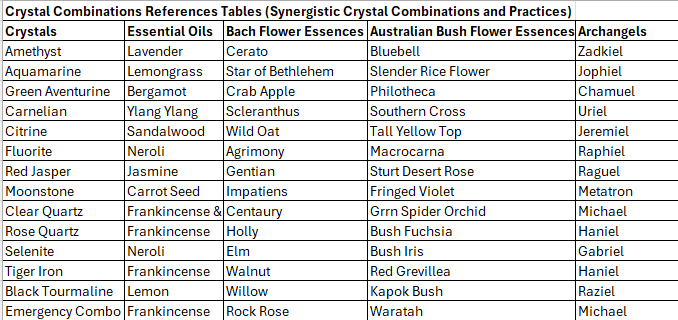
After each crystal, oil, flower essence, and archangel is introduced, Selman offers a meditation to connect with that crystal’s energy.
I couldn’t wait to try all the different combinations in my diffuser.
As an artist, I incorporate meditation, music, and aroma into my space to give me the maximum creative inspiration.
I love lavender, so adding cerato and bluebell to my diffuser created another level of tranquility and inspiration.
This book is an easy-to-read, comprehensive book for anyone seeking information about using crystals, essential oils, and flower essences for their highest good.
Selman is a passionate, thorough, tried-and-true believer in using crystals, oils, and flower essences to promote healing and well-being.

The Psychology of Money by Morgan Housel
https://www.goodreads.com/review/show/6053945251
In this book, Morgan shares his timeless lessons on wealth, greed and happiness.
He explains that finance is guided by people’s behavior and people’s behavior is unpredictable, based on their emotions, personal experiences and behaviors.
“To grasp why people bury themselves in debt you don’t need to study interest rates: you need to study the history of greed, insecurity and optimism.”
What about Warren Buffet? Warren started investing at age 10, when he was 30, he had a net worth of $1 million. Currently, at 90, Buffet has a net worth of more $81 billion. In his late 60’s he accumulated over $70 billion.
“Buffet’s fortune isn’t due to just being a good investor, but being a good investor since he was a child.”
“The real key to his success is that he’s been a phenomenal investor for three quarters of a century. Had he started investing in his 60’s, few people would have ever heard of him.”
“His skill is investing, but his secret is time.”
“Compounding isn’t intuitive so we often ignore its potential and focus on solving problems through other means. Not because we’re overthinking, but because we rarely stop to consider compounding potential.”
No book has been written about Buffet’s success that tells the story about Buffet being a consistent investor for over three-quarters of a century. “But we know that’s the key to the majority of his success.”
“That’s how compounding works.
If something compounds – if a little growth serves as the fuel for future growth – a small starting base can lead to results so extraordinary they seem to defy logic. It can be so logic-defying that you underestimate what’s possible, where growth comes from, and what it can lead to.”
“Investing is about earning pretty good returns that you can stick with and which can be repeated for the longest period-of-time. That’s when compounding runs wild.”
So, can you get rich living in America if you’re not Warren Buffet?
What are the chances of you becoming a billionaire in real time America?
It’s 1945. World War II ends.
Sixteen million Americans – 11% of the population – served in the war.
The average age was 23.
Within 18 months, all but 1.5 million returned home.
“Returning soldiers faced a severe housing shortage,” because no homes were built during the war.”
“All production capacity was shifted to building war supplies. Fewer than 12,000 homes per month were built in 1943, equivalent to less than one new home per American city.”
Where would the returning soldiers work?
“The specific jobs created during the war – building ships, tanks and planes – were very suddenly not necessary, stopping with a speed and magnitude rarely seen in private business. It was unclear where soldiers could work.”
“The marriage rate spiked during and immediately after the war. Soldiers didn’t want to return to their mother’s basement. They wanted to start a family, in their own home, with a good job, right away.”
So, America kept the interest rates low. “This wasn’t an easy decision, because when soldiers came home to a shortage of everything from clothes to cars, it temporarily sent inflation into double digits.”
In 1942, the Fed announced it would keep short-term rates at 0.38% to help finance the war. Rates didn’t budge a single basis point for the next seven years. Three-month Treasury yields stayed below 2% until the mid-1950’s.”
“The explicit reason for keeping rates down was to keep the cost of financing the equivalent of $6 trillion we spent on the war low.”
“But low rates also did something else for all the returning GI’s. It made borrowing to buy homes, gadgets, and toys really cheap.”
“Consumption became an explicit economic strategy in the years after World War II.”
“An era of encouraging thrift and saving to fund the war quickly turned into an era of actively promoting spending.”
Two things fueled this push.
The GI Bill. This bill “Offered unprecedented mortgage opportunities. Sixteen million veterans could buy a home often with no money, no interest in the first year, and fixed rates so low that monthly mortgage payments could be lower than a rental.”
“The second was an explosion of consumer credit, enabled by the loosening of Depression-era regulations.”
“The first credit card was introduced in 1950. Store credit, installment credit, personal loans, payday loans – everything took off.”
“And interest on all debt, including credit cards, was tax deductible at the time.”
“Household debt in the 1950’s grew 1.5 times faster than it did during the 2000s debt splurge.”
“The Great Depression had supercharged resourcefulness, productivity and innovation.”
“We were really good at making appliances, cars, phones, air conditioning and electricity.”
“The GI’s, “married, eager to get on with life, and emboldened with new cheap consumer credit, they went on a buying spree like the country had never seen.”
“Pent-up demand for stuff, and our newfound ability to make stuff, created the jobs that put returning GIs back to work.”
“And they were good jobs, too. Mix that with consumer credit, and America’s capacity for spending exploded.”
The answer to the questions of what the GIs would do after the war was “Buy stuff, with money earned from their jobs making new stuff, helped by cheap borrowed money to buy even more stuff.”
“The defining characteristic of economics in the 1950’s is that the country got rich by making the poor less poor.
“Average wages doubled from 1940 to 1948, then doubled again by 1963.”
“The gap between rich and poor narrowed by an extraordinary amount.”
“…A steel workers family who used to live on $2,500 is now getting $4,500 annually or the highly skilled machine-tool-operator’s family who used to have $3,000 now has $5,500 or more.”
“The top one percent, the really well-to-do and the rich, whom we might classify very roughly indeed as the $16,000-and-over group, their share of the total national income, after taxes, had come down by 1945 from 13% to 7%.”
“This was not a short-term trend.”
“Real income for the bottom 20% of wage earners grew by a nearly identical amount as the top 5% from 1950-1980. “
“The equality went beyond wages.”
“Women held jobs outside the home in record numbers. Their labor force participation rate went from 31% after the war to 37% by 1955, and to 40% by 1965.”
“Minorities gained, too although the rights were still a fraction of what they are today.”
“The leveling out of classes meant a leveling out of lifestyles.”
“Normal people drove Chevys. Rich people drove Cadillacs. TV and radio equalized the entertainment and culture people enjoyed regardless of class.”
“Mail order catalogs equalized the clothes people wore and the goods they bought regardless of where they lived.”
This was very important.
“People measure their well-being against their peers. And for most of the 1945-1980 period people had a lot of what looked like peers to compare themselves to. Many people – most people – lived lives that were either equal or at least fathomable to those around them.”
“The idea that people’s lives equalized as much as their incomes is important.”
“The debt-to-income from 1947-1957 was manageable.”
“Household debt-to-income today is just over 100%. Even after rising in the 1950’s, 1960’s and 1970’s, it stayed below 60%.”
The home ownership rate in 1900 was 47%. By 1970, it was 62%.
“A substantial portion of the population was now using debt that previous generations would not – could not – have accessed.”
To recap:
America is booming.
It’s booming together like never before.
- It’s booming with debt that isn’t a big deal at the time because it’s still low relative to income and there’s a cultural acceptance that debt isn’t a scary thing
When Baby Boomers began coming of age, they had a different view of normal.
“The idea that someone earning a 50th percentile income shouldn’t live a life dramatically different than someone in the 80th or 90th percentile. And that someone in the 99th percentile lived a better life, but still a life that someone in the 50th percentile could comprehend.”
“That’s how America worked for most of the 1945-1980 period.”
“President Clinton boasted in 2000 State of the Union speech:
“We begin the new century with over 200 million new jobs; the fastest economic growth in more than 30 years; the lowest unemployment rates in 30 years; the lowest poverty rates in 20 years, the lowest African-American and Hispanic unemployment rates on record; the first back-to-back surpluses in 42 years and next month, America will achieve the longest period of economic growth in our entire history. We have built a new economy.”
“The biggest difference between the economy of the 1945 – 1973 period and that of the 1982-2000 period was that the same amount of growth found its way into totally different pockets.”
“Between 1993 and 2012 the top 1 percent saw their incomes grow 86.1 percent, while the bottom 99 percent saw just 6.6 percent growth.”
“It was the opposite of the flattening that occurred after the war.”
“Rising incomes among a small group of Americans led to that group breaking away in lifestyle. They bought bigger homes, nicer cars, went to expensive schools and took fancy vacations.”
Everyone was watching, fueled by the internet.
“A culture of equality and togetherness that came out of the 1950’s -1970’s innocently morphs into a Keeping Up with The Joneses effect.”
Trying to keep up, more and more Americans take out huge mortgages, and massive credit card debt. They lease two cars and their kids graduate with heavy student loans.
It’s a big stretch to keep up with that same lifestyle.
“The share of income going toward debt and lease payments is just over 8% for the highest income groups – those with the biggest income gains – but over 21% for those below the 50th percentile.”
People start taking on more debt than they can service and the debt crisis begins.
“A lot of debt was shed after 2008. Household debt payments as a percentage of income are now at the lowest levels in 35 years.”
“The Fed backstopped corporate debt in 2008. That helped those who owned the debt, mostly rich people.”
“Tax cuts over the last 20 years have predominantly gone to those with higher incomes. People with higher incomes sent their kids to the best colleges. Those kids go on to earn higher incomes and invest in corporate debt that will be back-stopped by the Fed, own stocks that will be supported by various government policies, and so on.”
Since the early 1980’s, “The economy works better for some people than others. Success isn’t as meritocratic as it used to be and, when success is granted, it’s rewarded with higher gains than in previous eras.”
It’s not the same reality as it was. It’s not working anymore and people want it back.
The new reality is, “We need something radically new right now!”
So, right now, the reality of your chance of becoming a billionaire, based on the statistics, depends on whether you’re in the 1 or the 99 percentile and when you started investing.
Lessons in Chemistry by Bonnie Garmus
It’s the 1950’s. Elizabeth is a smart, budding scientist. It’s tough being smarter than your colleagues, especially if they’re male. This is a very clever, sad, funny book that I couldn’t wait to finish. Elizabeth makes lemonade out of a tower of lemons!

A Woman of No Importance by Sonia Purnell
A truly inspirational – true book about a physically challenged female Boston socialite spy that changed the course of WWII.
This is a must read! It’s difficult to believe it’s all true!
Walking the Medicine Wheel: Healing Trauma & PTSD
David R. Kopacz MD and Joseph Rael (Beautiful Painted Arrow)
Returning veterans, after serving their country in wartime, have little direction in assimilating back into society in peacetime. They cannot find peace.
They have been trained to be able to kill other people and are exposed to many atrocities in their work. They are trained to be able to override their innate compassion toward their fellow human beings and to fight and kill the enemy.
“All veterans know that military training involves a lot of intentional suffering – boot camp, strength training, and the cultivation of mental and physical discipline. In addition, military training is continuous. It must be renewed continuously to be maintained. Why should civilian training for peace be any different? Why should not being peace-ready also require continual training?
“We follow the circular path of the medicine wheel to chart a course to help bring our veterans and our country back to a state of peace in our hearts, minds, bodies and souls.”
Psychiatrist and holistic and integrative physician Dr. David Kopacz and Native American Visionary Joseph Rael (Beautiful Painted Arrow) have created a path back to healing from trauma based on the circular pathway of the medicine wheel to retrain the nervous system.
“We have written this book to support veterans and all trauma survivors so that they may be able to return home to a sense of peace in their hearts and minds after war and trauma.”
“This is the primary paradigm shift we offer in this book – seeing trauma as an opportunity for deeper human initiation rather than only as a ‘disorder.’”
The medicine wheel path of healing includes pain and suffering as stepping-stones rather than “symptoms” to be thrown away or gotten rid of.”
Dr. Kopacz and Joseph Rael are groundbreakers affirming “trauma is a normative response to horrific events; it is transformational; the survivor has had liminal and visionary experiences in non-ordinary consciousness and reality; trauma can be understood and worked with as a rite of passage that leads to growth, wisdom and initiation.”
“The medicine wheel and Native American traditions give suffering a place to be. When suffering is given a place to be, transformation and healing can occur.”
“Ceremonies are the individual and universal benefit – what the individual goes through, society goes through as well and vice versa. This is the universal principle of interconnectedness, ‘as above, so below.’” “The person is the microcosm of the macrocosm.”
Vietnam veteran John Wesley Fisher writes, “When the war continues in its veterans, it continues in the country as a whole, as well.”
“The medicine wheel is a circle – it includes everything and excludes nothing. It integrates past and present. The medicine wheel is a multi-dimensional structure.”
“The medicine wheel is the circle of life. The circle of the medicine wheel embodies the four outer directions (east, south, west, north), the four inner directions (mental, emotional, physical, spiritual), the four outer seasons (spring, summer, fall, winter), and the four inner seasons (childhood, youth, adulthood, middle age, and old age).
“There are four colors: red, yellow, white and black. The four directions and four colors represent four different human dimensions. Each direction also has a sound vibration: a, e, I, (with u at the center).
“For now, we can say that healing helps a person have a sense of who he or she is, and it gives that individual a sense of place. Hearing one’s story reflected four times brings a person around the four directions of the medicine wheel, and by walking this journey, he or she heals.”
“Do not come to be instructed. Come to be initiated.”
The medicine wheel is also the way that we process experiences and how we grow. “…we have to let go of our old self so that we can move into the self and integrate new and old into a coherent whole.”
“Walking the medicine wheel is the hero’s journey of separation, initiation, and return. Veterans separate from their homeland, from their friends and family and even from their own previous identities. The initiation is book camp, being deployed, and for some, war and combat. The return is he most complicated part. The veteran returns home in body, but there’s often something missing, some incomplete part of the initiation and the return.”
“When we are disoriented, the world no longer makes sense, even our own lives make no sense. We are lost. When lost, we need to find our bearings and re-orient ourselves. There are inner and outer worlds and re-orientation requires walking in both realms.”
“Separation is the call to adventure that takes one away from the everyday world. Initiation is the challenge, the trial, and it is the acculturation to a new world, an unknown world. Return is the journey home, with new knowledge, a new sense of self, and a gift or boon to give to society.”
“Try to take away the wound and you lose the gift. Go into the wound and realize the gift for yourself and society.”
“Even when out of the war zone, combat-readiness persists in the veteran’s nervous system. This is due to training and traumatic experience. Indigenous cultures and ancient cultures had ceremonies and rituals to help returning veterans re-train their nervous systems and re-acculturate to civilian culture.”
The Sassana Stone – The Sheriff’s Catch by James Vella-Bardon

“This would make a wonderful swashbuckler movie” was my first thought after reading this book!
This book has all the elements of a feature film! A daring action-packed historical adventure, romance, exotic lands, and cultures set in 1600s Ireland.
I felt James Vella-Bardon’s depth of knowledge of the times and his depth of character was unparalleled.
This book has won numerous awards, including the winner of the “best novel” and “best historical fiction” categories at the international Royal Dragonfly Book Awards in 2019.
Written as a pentalogy in the first person, this book put me in the middle of all the action! The good, the bad, and the evil! It is total death and destruction in gory detail.
Through his vivid descriptions, I felt I was there, living the life of a foreigner under siege by numerous marauding forces, including the feared “Sassenachs” or Saxons, as the Irish referred to them.
This book is a pentalogy, opening the door to many more of Abel’s adventures.
This is the story of Abelardo de Santiago, also known as the “Lynx of Haarlem,” and “Santiago the Sniper,” a Spanish sharpshooter raised as an orphan in Malta who joins the Spanish Armada and ends up in the Netherlands.
A vicious war raged in the Netherlands for nineteen years after Protestant rebels revolted against King Phillip II of Spain, who sent his best troops to crush them.
At that time, Spaniards were triumphant in battle and feared all over Europe. Spanish “tercios” were the world’s best-trained, most highly feared soldiers. Some say they are the best troops the world has ever known.
Despite the unwelcomed presence of Spanish soldiers in the village of Willebroek, outside of Antwerp (at that time, Antwerp was part of the Spanish Netherlands) and the day-to-day suffering the war inflicted, Abel falls in love. He marries a wealthy local miller’s daughter.
Abel has a bright future planned with his now pregnant wife when one of his Spanish “friends” kills her and her father for non-payment of “protection money” (the fire tax) and burns their house down.
The very same soldiers who had been ordered to protect them killed them, and their deeds went unpunished.
In a blind rage with a death wish, Abel deserts the Spanish army. Along with his dead wife’s brother, they set off to find the soldiers that killed his wife and to get revenge at all costs.
Abel and his brother-in-law return to Spain, following their prey, but inadvertently are tricked by their pursuers and captured by a brutal sheriff. They were sold into slavery on the auction block as galley enslaved people or “forced rowers,” rowing one of the Spanish Armada hospital ships docked in Seville. They were scheduled to depart for Lisbon with two other warships.
While rowing as a galley enslaved person, Abel sees a young lord, the Prince of Ascoli, on board the hospital ship and becomes mesmerized by the sizeable emerald ring he is wearing. Abel had never seen anything quite so exquisite.
Being a veteran soldier, comfortable finding himself in impossible situations, Abel hatches an escape plan to enable him to reengage his revenge plan.
His plan works. He escapes the ship, only to be thwarted by his adversaries when he flees on horseback from a stable and again finds himself back on the hospital ship, scheduled to leave for England with the Spanish Armada.
This time, thanks to a former captain who recognizes him, Abel and his brother-in-law are sent up to the crow’s nest at the top of the galley instead of rowing at the bottom.
The ships sail, and Abel finds himself battling with the English. The Spanish Armada, in combat, was regularly boarded by grappling hooks and engaged in hand-to-hand combat until death.
The English fleet was different!
The English fleet never engaged with the Spanish Armada with grappling hooks. Their ships outmaneuvered and darted past the Armada with their guns and cannons blasting.
They were swifter and better equipped.
Abel sees the fleet bombarded by balls and canisters; his hospital ship is struck. Somehow, the galley continues sailing around the sea of Norway, trying to return to Spain by going around Scotland and Ireland, but gets caught in a squall two miles off the coast of Ireland.
Abel participates in a slave revolt, is swept overboard, and swims to shore before the ship sinks below the waves.
The beach is besieged by bandits. Abel, hiding in the bushes, watches the other Spaniards being beaten senseless by thieves.
English troopers arrive carrying white shields with a red cross of St. George, attacking the remaining Spaniards.
As Abel hides in fear, he watches the ship and his former life slip away.
He manages to find a native village where he temporarily takes refuge. He learns from a native leader that they refer to the English mercenaries as “Sassenachs,” or Saxons, who are “killing all the Spaniards and all those that help them. “
The leader warns Abel, “The enemy wants all Spaniards tortured and killed,”
Abel learned from the leader that the only place in Ireland where he could find refuge was in Northern Ireland. “They still resist the yoke of the Sassenachs and refuse to pay tribute to the crown.”
“Their alliance is to the King of Spain.”
Only moments later, the Sassenachs arrive, led by Sargent Treasach Burke, who serves under the Sheriff of Sligo and tells the leader he is under orders from the Viceroy in Dublin, and that the crown gives him the right to seize, torture, and execute all Spaniards and all those who would help them.
Burke quickly disposes of the leader, captures Abel, and takes him back to a castle in Sligo Town, where they’ve created make-shift gallows and a torture chamber.
Burke bows as Lieutenant John Gilson arrives on the scene. Twelve local Irishman are chosen from the prisoners and hung, all hostile to the English crown.
Lieutenant Gilson leads Abel to the dungeon, where other shipwrecked Spaniards are being held captive and tortured.
Sheriff George Bingham arrives, who once fought under King Phillip but changed sides. One day, the Sheriff boasted, “We put six hundred Spaniards to death.”
The Sheriff demands that the captured Spaniards tell them all they know and tortures Abel.
Burke continues Abel’s torture.
Abel knows he is about to be killed, so he lies about who he is, knowing officers are always ransomed and tells Burke he is the son of Don Gaspar de Hurtado’s son, the hospital ship’s head physician.
Burke shouts, “Where is the emerald?”
A few seconds later, Don Gaspar, the elder, arrives as a new prisoner. Abel pleads with the elder to keep up his cover as his son. Together, they kill Burke.
Burke manages to get the emerald from Don Gaspar, then Abel kills Don Gaspar and escapes the dungeon dressed as Burke with the emerald, which he swallows.
The castle was under siege by Irish natives, enabling Abel to escape in the ensuing chaos. He flees into the forest only to be pursued by English wolfhounds, who unfortunately catch up with him in a river, biting and ripping his skin open.
His only thoughts were that he had survived and had the emerald ring. “I could not help thinking that I had perhaps secured wealth and freedom and that my fortunes might have turned beyond expectation.”
Abel, wounded and unable to defend himself, drifts down the river. He comes across a native village where he steals some bread. He hears distant horsemen and warns the villagers, “Sassanas!”
In the middle of the Sassanas raid, Abel recognizes Lieutenant John Gilson as the leader of the massacre.
Abel sees one native, larger and more forceful than all the rest, shot down by Gilson.
Abel knows he must escape and sees a smaller native kneeling in despair over the larger one just killed.
Abel sees a horse, hits the horseboy on the head with a rock, steals the horse, then throws the small native on his horse, hoping to use him as a guide, and gallops into the forest, leaving the raid behind.
When a wall of trees confronts Abel and his guide, Abel realizes his native is not a lad but a lass!
She tries to escape and go back to the village. “I can’t leave him to the Sassenachs!” She takes the horse and leaves Abel bewildered, only to return in despair, realizing she can do nothing. Her husband was the one shot by Gilson.
They continue together to her village, where Abel learns from a clergyman that his guide, Lady Muireann is an “ollamh,” or “master of learning” and held in high regard.
Her husband, Aengus, was killed in the raid, escorting Lady Muireann to a gathering.
Abel joins forces with Lady Muireann and the natives using and teaching his sharpshooting skills. During his first mission, he finds only two of the four men alive he had been pursuing for revenge.
Even though Abel finds himself trapped in an unfamiliar world, he knows the emerald will provide him safe passage to the New World and a new life.
Continuous and Embedded Learning for Organizations

In today’s competitive corporate environment, if you’re standing still, you’re losing ground! Success today does not guarantee success tomorrow.
How does any organization stay ahead of the competition? What steps can ensure an organization’s bright, long, prosperous future?
This book is like being thrown a floatation device when you’re drowning!
The authors identify complex learning topics that can be turned into behaviors embedded into daily work habits.
James Clear, author of Atomic Habits, states, “Habits are mental shortcuts learned from experience. In a sense, a habit is just a memory of the steps you previously followed to solve a problem in the past.” “The primary reason the brain remembers the past is to better predict what will work in the future.”
“For an organization to be an effective global competitor, it will require constant learning by the individual team members that enable the organization to become increasingly competent and efficient and able to discover new opportunities and effectively take advantage of these. This ultimately requires more than the individual to learn, but team learning, and learning that spreads through the organization.”
“A learning organization neither waits for an issue to implement change nor wastes an opportunity for change even during a change itself.” “…the cycle of learning and action is consistent and part of the organization’s structure itself.”
The authors state, “This book provides an overview of the many systems, both social and technical, required to create a learning organization, as well as ways to capture and propagate learning throughout the organization. The longevity of the organization depends upon the ability of that organization to learn and propagate that learning throughout the organization.”
“This book also explores the difference between learning and knowledge and how these two different mindsets are commonly misunderstood. This approach is instrumental in knowing what, when, where, why, and how to plan and execute a plan for motivating your personnel, developing your organization, and using your project to obtain both.”
“Learning is how we gain knowledge, and that knowledge is the logical application of what we have learned.” “While most organizations understand that in today’s environment, change is inevitable, they do not relate this change to what is being learned or the need for learning, but to what new technology is available. Technology is not necessarily the savior of the organization. Organizational development is a manner to bring about planned change.”
“Tools are not the savior of the organization; it is the talent.”
“While we know from years of experience working as team members and team leaders, one size does not fit all and must be tailored to not only the people but the organization and the project, that is why the approach is to show opportunities and allow you to determine the when and how of the application.”
Organizations pride themselves on their mission or vision statements, but are they relevant?
“We have all been part of organizations that have a mission or vision statement that says its people or innovation, or some other catchphrase, are key to their success, but when you delve into how these actually stack up in what and how the organizations run they are but curtains on a broken window: look nice but have little to do with how the organization operates.”
The authors state, “We are believers that embedding development: personnel and organizational, into everyday processes, in project plans and aligning this development with the mission or vision statement of the organization will reduce the chance of these items being reduced or even stopped during times of need.”
“To remain relevant, the organization must constantly work to understand and adapt to the external environment as well as improve the internal environment.”
The authors reference one of my favorite TV series, Airplane Disasters, broadcast on the Smithsonian Channel.
The relevancy of Airplane Disasters to organizational disasters is the same. When airplanes or organizations crash, the reasons are complex. There is usually more than one thing that brings down the plane or organization!
We tend to jump to conclusions about the failures. “It is seldom the first thing we think is in fact, the problem. There is also a significant chance that the root cause is not, in fact, a single thing, and very likely not the single thing we may immediately believe to the problem often based upon biases and experiences.”
“There is only one thing more painful than learning from experience, and that is not learning from experience.”
“Learning provides the mechanism for improvement. We learn what does not work; we explore to find what may work and experiment to ascertain what will work. We work to understand those things that limit our performance, hindering us from the objectives we wish to achieve, and then work with our team members to devise potential solutions to overcome these limitations, then experiment with potential solutions, learning along the way.”
“Most organizations fail to exploit their lessons learned because their focus is on the now instead of the long term.”
“Each failure, each success provides us with an opportunity to learn. If we take and maximize that opportunity (spread throughout the organization), we become stronger as an organization. We learn more as a group about what works and what does not work. This is helpful for the product and for the project, but we must pay attention to what is going on and listen to those that have learned lessons that we have not yet learned, as well as teach lessons to those who have not learned. Student and teacher are one and the same.”
“Good judgment comes from experience, and experience comes from bad judgment.”
“Many people may consider change as something that occurs only when something happens to cause it or when a new plan or process is enacted. However, change is always occurring even when there is no visible cause (issue or accident) or even a plan for it.”
The authors state, “…plan for an opportunity rather than react to a situation.”
“In 1948, 3M introduced a unique program that quickly became one of the signature elements of the company’s reputation for innovation. The 15% program, which continues today, allows employees to dedicate up to six hours a week to their own projects, to range beyond the responsibilities of their job, hatch their own ideas, and see what can become of them. The program is a perk that delivers benefits both to the individual and the company. Among other innovations, the company attributes the invention of Post-it Brand notes to 15% time.
“Understanding what works well or the strength of the company is like discovering gold nuggets. These are the areas that can propel the organization to truly new heights. When we see what works, we can work to move these things that work in one location for consideration to other parts of the organization.”
This book provides organizations with a step-by-step embedded learning plan tailored to their specific needs for their immediate and long-term success.
During a recent team-building event at work, I had the opportunity to share some of the book’s examples of how teams can be made stronger. The stories popped into my mind because they were relevant to the situation.
Isn’t that the litmus test of any book? Can you use what you know?
Yes! I was able to use some of my new-found knowledge and share these nuggets of relevant information with my team of co-workers!
Quantum Physics for Hippies
By Dr. Lukas Neumeier & Dr. James Douglas
A book review by Allison Constantino
ISBN –9781091891166
Published April 2019

Are you a truth-seeker? Are you always looking at things and wondering, “Why?” then this book is for you!
Dr. Neumeier and Dr. Douglas have created a fun dialogue between Alice, the scientist nerd and Bob, the spiritual hippie that attempts to explain the possibly unexplainable – the strange theory that describes the behavior of atoms and light – quantum physics.
“The common denominator …. each hippie and each nerd – is simply looking for the truth.” “The truth about who we are and how we fit into the universe. This search unites us all, regardless of social conventions.”
I’m an artist, not a mathematician or scientist. However, being an artist means that I’m always amazed and puzzled at what I see and that means everything I see around me. I want to know “why” things are like they are! I demand answers!
That’s why quantum physics has always intrigued me. In this book, I love the clever dialogue between Bob and Alice and their attempts to present simple answers to complex questions – and according to Occam’s Razor Theory, “The simpler the theory is, the more likely it is to be true.”
I love trees so I was pleasantly surprised to learn from Bob and Alice, “The atoms in our bodies are exactly the same as those in any tree, plant, animal, rock or star – and for some reason – those atoms organize themselves into a human.”
So, we’re all atoms, some of us are tree atoms and some of us are human atoms!
More mind-blowing information Bob and Alice share with us in their idle banter:
- In each single electron is the whole pattern.
- Information can’t be created or destroyed – just passed on.
I’ve always loved films about parallel universes and how they manifest, so I was totally intrigued by this thought, “It’s the parallel existence of infinite beings having all possible experiences at the same time. You’re never reborn – you’ve always existed.”
I didn’t quite grasp that, so fortunately Bob provided this insight. “There is just one everlasting unbreakable quantum wave. Inside that wave there are multiple Bobs occupying multiple universes, having different experiences, leading different lives, but the different universes can’t communicate with each other. So, each Bob thinks he is living in the only universe and each Bob is convinced he is the only Bob.”
I was really intrigued to discover “connected possibilities,” or “entanglement” that two possibilities exist simultaneously. Schrodinger’s Equation shows how a cat can be dead and alive – simultaneously.
More insights shared by Bob and Alice include “There are many of you. You are a multi-dimensional being living in many universes at once.”
“Conscious experience in a body which is dead or in a deep sleep – stops. But, globally, conscious experience goes on and if you are really consciousness itself, and there is only one consciousness as you say, your next possible experience must be an experience. You can’t experience not experiencing. You would experience the process of dying, but then you would instantly have another experience. Maybe you’d find yourself looking through another configuration of atoms. A new body. But that new body only remembers being that body, because it comes with its own memory, and for you, it feels like you have always been with that body.
“So, consciousness would experience dying, but would never remember it.”
Bob and Alice offered some parting take-away thoughts, “The Holy Grail is to see yourself as nothing and everything at the same time. Then you feel unshakable stability, complete freedom of any experience. While at the same time, feeling love and compassion for whatever appears inside of consciousness.”
An ending and beginning insight from Bob, “I believe that gaining full awareness of the mind is the next step to human evolution.”
Where will our minds take us tomorrow?
Dr. Lukas Neumeier currently works at the Darrick Chang Group, ICFO Institute of Photonic Sciences, with a focus on atomic, molecular and optical physics, condensed matter physics and quantum physics. The group’s most recent research publication is “Reaching the optomechanical strong coupling regime with a single atom in a cavity.”
Dr. James Douglas is a physicist with a research focus on ultracold quantum gases.
Jun Matsuura is an artist specializing in pencil drawings.
Count Down by Matt Phillips
ISBN # -13: 978-1-948-235-84-6
If you like crime-fiction, this one’s for you! A deep dive into the “legal” marijuana business where cash is more readily available than an ATM and two gutsy war vets are determined to get a piece-of-the-pie!
“With the legalization of marijuana in California and the federal illegality of the drug, there’s a teeny weeny money problem. You can grow weed. You can sell it. You can smoke it and you can eat it. You can do just about whatever you want with it. You can’t put it in a bank because the IRS will start asking important questions. So, what do you do with it?”
Ten thousand a day. Every day. In cash! You can MAKE it, but where can you PUT it?
Set in San Diego, this book reads like a really low-life “American Greed!” Two war vets back from Iraq (a.k.a. EYE-RACK) are looking for their next gig. One-half of the dynamic duo starts his own marijuana “security” company! He’s got the guts and the firepower!
All these marijuana “dispensaries” need a place to store their cash while it’s being “laundered.” That takes time and in the mean time, the cash, thousands and thousands and thousands of dollars of cash – just sits there for the taking! Somebody has to pick up the cash every day and “store” it!
“Storing” thousands of dollars every day in duffel bags in a storage unit is a recipe for disaster! With those kind of high stakes, everybody is looking for an angle to get rid of their competition. This is a dog-eat-dog world! Every guy is in it for himself!
So, who better to rob the dispensaries than the guy(s) set up to “secure” them. Enter the other half of the duo. Unfortunately, things don’t always go as planned and these two hard-luck soldiers lead you down every seedy back street and dive in San Diego.
Our war vets for one reason or another, one-by-one end up with the short end of the stick! So much for the best-laid plans. Guts will only get you so far, and in this case, our heroes are picked off one-by-one.
Three Hours Past Midnight by Tony Knighton
Reviewed by Allison Constantino for Crime Wave Press
Published by Crime Wave Press December 2017
ISBN -10 9881493854
ISBN-13 978-9881493859

If you enjoy a 50’s style, no-nonsense crime read, you’ll enjoy this fast-ride connecting-the-dots in Three Hours Past Midnight.
You’re in for the ride of your life, as you go from one low-life place in the seedy under-belly of Philadelphia, to the next, with a veteran violent thief as he tries to track down his money lost in a job with his partner, a retired cop, who ends up dead!
This book gives new meaning to the phrase, “all-in-a-days-work,” as our thief looks all over Philly trying to find his loot and meets up with every unsavory character imaginable, including corrupt politicians, every low-life thug in the neighborhood and even illegal immigrants.
I ended up knowing a lot more than I wanted to know about how to be a good thief, honor amongst thieves, and how crime really does pay!
I loved the author’s quotes:
“His eyes told the truth. They were dark, and hard, and they never stopped moving. He looked at my face, my hands, around me, through me, frisking me with those eyes and coming back to me again. Raco would make a point of remembering everything.”
“What do I always say? If you want someone to believe your story, they have to tell it to themselves.”
“…He was right. This business was all a matter of attitude.”
From a reader’s perspective, I knew nothing about Philadelphia and even less about the every-day life of a veteran, violent thief, so it was an education for me on all levels. At every turn there seems to be a judge or politician on-the-take, a cop that “went bad” and a job that went south.
It’s a tough way to make a living, but that’s the way things are when you’ve chosen to be a career thief.
Taking the life of another person is just the cost of doing business, nothing more, nothing less. You do what you need to do to get what you need to get!
Tony Knighton is a 30-year Philadelphia Fire Department veteran and has lived in Philly since his early childhood. He definitely has his fingers on the pulse of Philly and passes that knowledge on to his readers.
Tony also played music semi-professionally for years and I personally enjoyed the way Tony weaved his love and knowledge of music into the plot seamlessly!
 AllisonsArtwork